
Do you think managing a business is all about numbers? It’s time to think again. Behind every compliant, well-governed organisation stands a key professional—the Company Secretary in Australia—who upholds transparency, accountability, and adherence to corporate laws. This authority serves as the guiding force for organisations balancing governance, legal obligations, and financial activities.
Whether you are managing a startup or leading a large-cap organisation, onboarding a Company Secretary can be the secret sauce to seamless and compliant business operations. From understanding their roles in the Australian business landscape and the responsibilities they carry, this blog will be a walkthrough of information for those waiting to build a foundation for long-term success.
What is a Company Secretary?
Primarily seen as an administrative position, the role and responsibility of a Company Secretary changed significantly in the late 1990s, following a period of corporate governance failure and tightened compliance demands. From then on, what was once a routine function like maintaining registers, recording board minutes and handling documentation evolved into a strategic and governance-focused role. Today, Company Secretaries play a pivotal part in shaping corporate compliance policies, guiding board directors on legal and regulatory responsibilities and maintaining transparent communication with stakeholders on organisational reforms and governance matters. But can just anyone become a Company Secretary? Not literally. With the expanding scope of responsibilities and the growing emphasis on corporate governance and compliance, the Australian government has strengthened the qualification requirements for this role.
Let’s understand the qualification requirements to become a Company Secretary in Australia.
Qualification of Company Secretary
While the role of a Company Secretary does not necessarily specify any particular qualification, appointing someone above the age of 18 years with a background in law, commerce, accounting, and governance. Such educational qualification helps with offering corporate and compliance support for the organisation. Additionally, having membership with the Governance Institute of Australia (GIA) or the Chartered Governance Institute (CGI) is considered a significant advantage, as this reflects your expertise in corporate governance and risk management.
In addition to formal education, as a Company Secretary having excellent communication and advisory skills will help you with liaisoning boards and regulators. These learnings and skills contribute to shaping governance policies, upholding ethical decisions and protecting organisations from legal laws and regulations. Though these qualifications are not mandated, they have become the benchmark for meeting today’s regulatory and boardroom standards in Australia.
When Do You Need a Company Secretary?
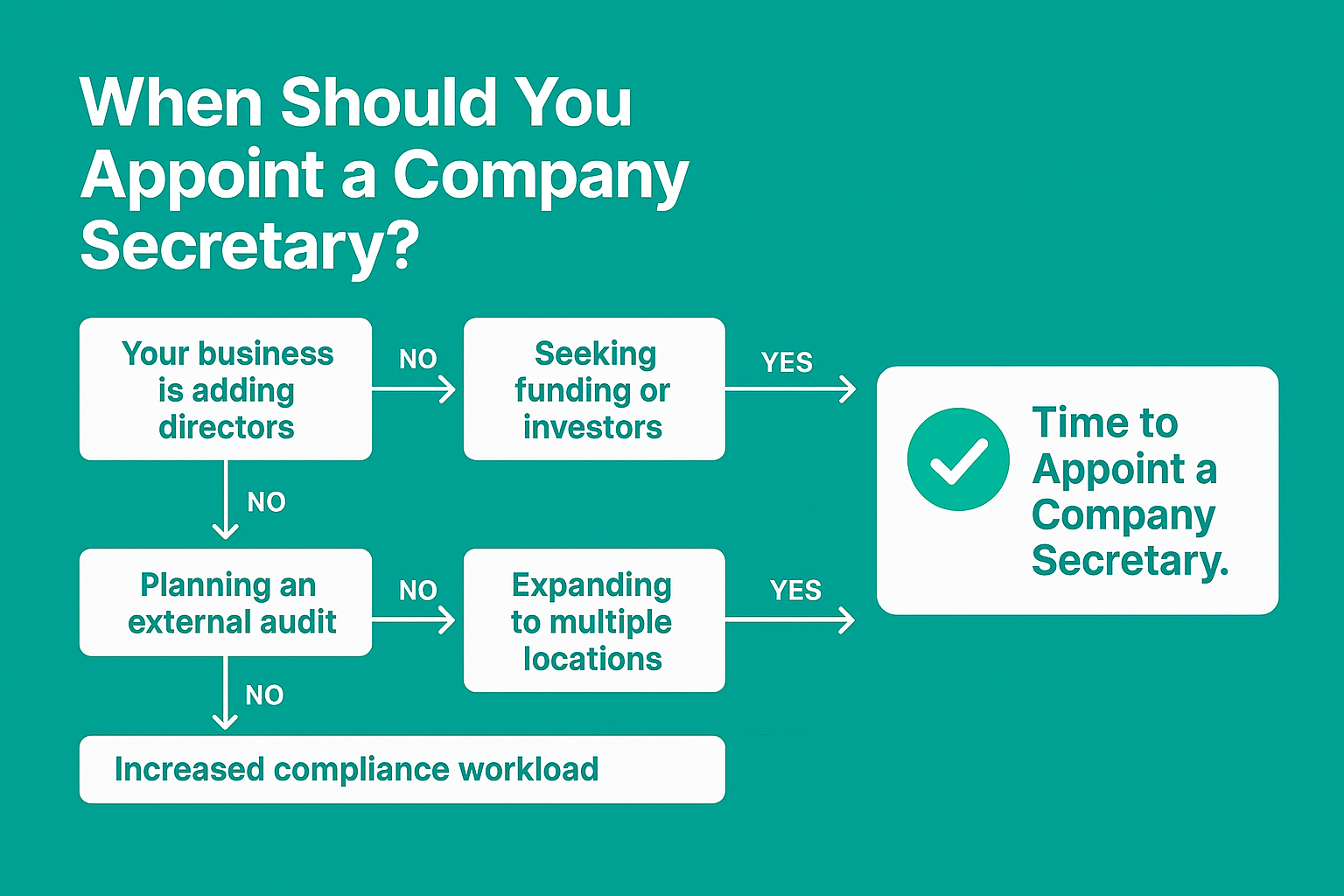
Many small businesses start without a formal Company Secretary. But if your business is growing, adding directors, dealing with investors, or preparing for external audits — it’s time to consider appointing one. A Company Secretary becomes crucial as your compliance requirements expand—just like having a reliable ASIC registered agent helps manage legal obligations efficiently. As board meetings become more frequent and legal documentation needs more precision, their support ensures you’re not just compliant, but also well-structured for long-term success.
Roles & Responsibilities of Company Secretary
In Australia, a Company Secretary is looked up for every business operations like governance, legal matters, ethical practices and advisory contributions. The role extends like it has no limit, so let’s categorize the role into four divisions.
Corporate Governance
Every organisation aims to function on the best terms that help them succeed in the long run. To achieve this, the role of a Company Secretary plays a significant step by supporting the organisation to operate within a governance framework that involves maintaining transparency, accountability and ethical decision-making. From gaining a deep understanding of the Corporations Act 2001 to communicating with the boards about each governance practice, why it matters for the organisation, and how to align with the company’s long-term goals, a Company Secretary ensures no gaps are uncovered.
Additionally, they also work on preparing board agendas, circulating meeting papers and maintaining accurate minutes of meetings, as these serve as legal evidence of board decisions.
Compliance & Legal Duties
Having a compliant organisation is where the real success lies, and a Company Secretary helps accomplish this by ensuring the company follows every requirement set forward by the governing bodies like the Australian Securities and Investment Commission (ASIC). From lodging statutory documents such as company reports, annual returns and director changes in line with the ASIC to keeping track of important deadlines and business insights, a Company Secretary makes sure every process in the organisation is not just compliant but also up-to-date, avoiding penalties and earning the board’s trust.
Communication & Liaison
All information related to an organisation is important and communicating this to the respective authorities is crucial for smooth operations. And this is responsibly carried out by the Company Secretary who serves as a link between the boards, stakeholders, investors and other key personnel. Although communication and liaison may seem like simple tasks, carrying them out effectively requires skill and Company Secretaries handle this by coordinating with authorities to ensure transparency and proper governance on financial matters, legal requirements and policy updates.
Strategic & Advisory
Guiding an organisation towards its long-term goals is a major task where a Company Secretary role fits in perfectly. From recommending policies and managing risks to staying updated on corporate terms, a Company Secretary act as a strategic advisor who impacts the organisation in the long run.
As strategic advisors, they make sure every major decision is backed by thoughtful studies and aligns with the corporate rules and the company’s performance. Over time, Company Secretaries often become trusted advisors to the board, helping maintain transparency, accountability and trust across the organisation.
Why Company Secretary Role Important in Australia
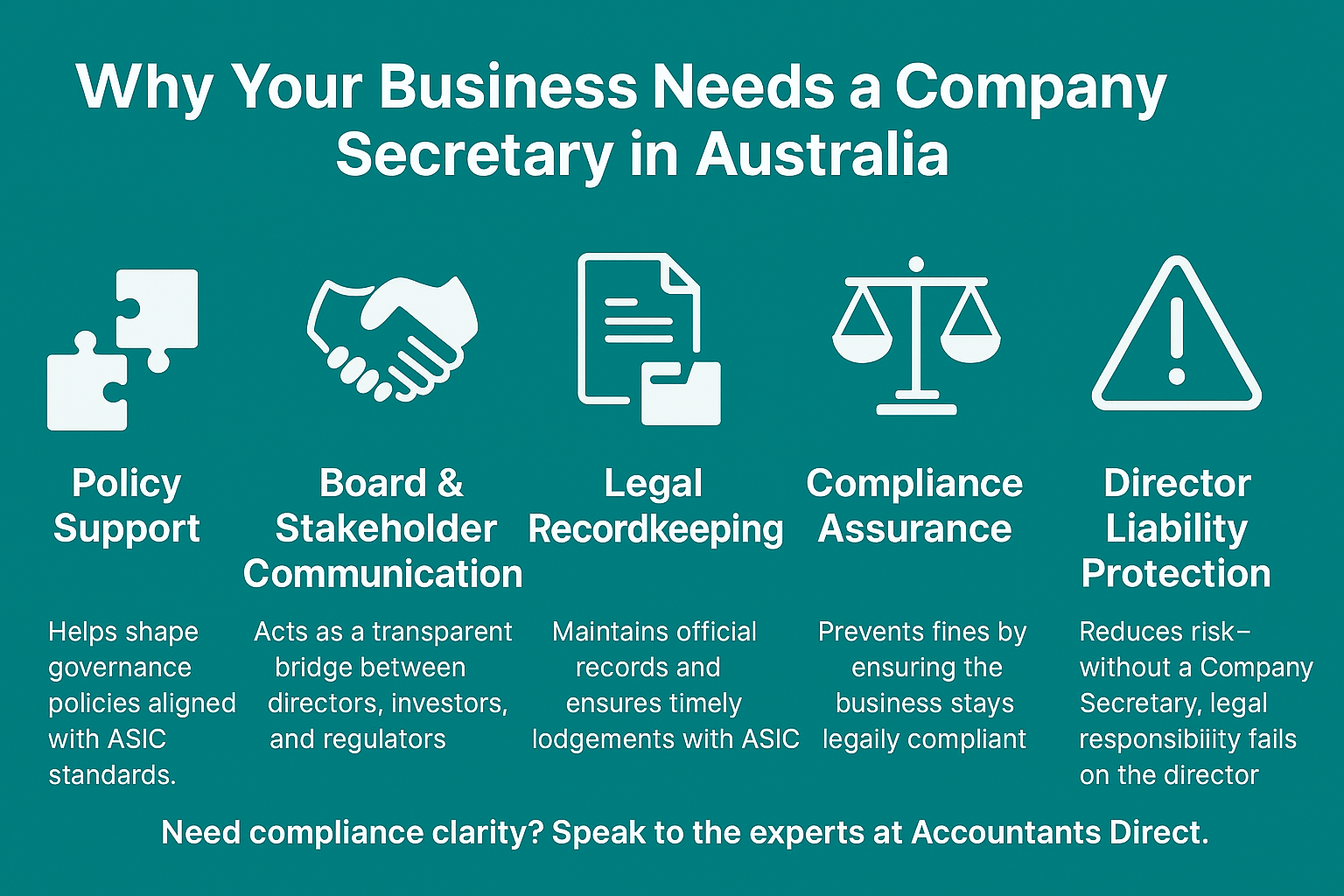
As a country with strict corporate regulations, Australia places great importance on compliance and governance. Having a qualified Company Secretary helps navigate these complexities and allows you to follow the standards set by the government authorities. Here’s why appointing a Company Secretary in Australia can make a real difference to your organisation.
- Assist in developing governance policies that align with the ASIC regulations and support the organisation’s long-term goals.
- Connects and communicates between boards of directors, stakeholders, investors and other regulating bodies, offering transparency and trust across all levels.
- Maintains accurate official records, including the directors, board members and the organisation’s to file statutory forms with the AISC.
- Holds responsibility for the company’s legal obligation; in the event of no Company Secretary, the director is held accountable.
| Need Help with ASIC Compliance or Governance? Speak with an expert at Accountants Direct today. 📞 Call 1300 829 746 or book your appointment. |
Conclusion
The role of a Company Secretary in Australia has evolved far beyond traditional administration. Whether you’re managing a small business or leading a multinational corporation, having a qualified Company Secretary can make a world of difference. From organising board meetings to formulating governance policies and offering strategic advice, they ensure that every operation runs within a framework that prevents compliance issues and legal penalties.
Appointing a Company Secretary in Australia is like making a strategic investment for your business stability and longevity. For businesses and aspiring Company Secretaries alike, seeking professional guidance from accounting experts like Accountants Direct—whether for bookkeeping, compliance, or ASIC support – can help you better understand governance policies and gain valuable insights to strengthen your organisation’s performance.
Frequently Asked Question
1. Is it mandatory to appoint a Company Secretary in Australia?
No, it’s not mandatory for all companies. However, public companies are legally required to appoint at least one Company Secretary. For private companies, it’s optional but highly recommended, especially as the business grows or faces complex compliance requirements.
2. What qualifications should a Company Secretary have in Australia?
While there are no strict legal requirements for private companies, it’s ideal to appoint someone with a background in law, accounting, governance, or commerce. Membership with the Governance Institute of Australia (GIA) or Chartered Governance Institute (CGI) is considered a strong professional asset.
3. What are the key responsibilities of a Company Secretary?
A Company Secretary oversees corporate governance, ensures legal and regulatory compliance, maintains statutory records, advises the board on compliance matters, and acts as a communication bridge between the board and stakeholders.
4. When should a small business consider hiring a Company Secretary?
You should consider appointing one when your business is expanding, onboarding new directors, seeking investment, facing an external audit, or dealing with increasing compliance obligations.
5. Can an accountant also act as a Company Secretary in Australia?
Yes, many accountants also serve as Company Secretaries, especially in small and medium-sized enterprises (SMEs). Their financial knowledge and understanding of corporate law make them well-suited for the role, provided they meet the governance responsibilities.